If you’ve ever stood on the other end of a production line, watching a 50-pound bag of rice, birdseed, or pet food roll off the conveyor belt perfectly sealed and weighed right on target, chances are that bag was filled by a net weighing bagger. For nearly 20 years, I’ve stood beside the production floor, talking with plant managers, line operators, and maintenance teams about why net weighing baggers are the workhorses of the packaging industry—and why so many operations used to rely on guesswork, manual checks, and wasted product before making the switch. As a net weighing bagger supplier, I don’t just sell machines; I explain how they work, because understanding the process is what makes operators feel confident and managers feel their investment is worth every penny. Net Weighing Bagger
Let’s start with a common misconception: a lot of people mix up net weighing baggers with other packaging equipment, like gross weighing systems. Gross weighing grabs the full weight of the bag plus the product, then adjusts to hit the right number—but that means you’re paying for the bag in the product’s total weight, which adds up to hundreds of dollars in wasted product every month for large operations. Net weighing, on the other hand, measures only the product itself before it goes into the bag, which is why it’s 2 to 3% more efficient for most dry bulk goods. That might sound like a small number, but when you’re bagging 10,000 units a day, that 2% adds up to 200 extra bags’ worth of product—gone to waste because the scale was counting the bag as part of the load.
So, how does a net weighing bagger actually do that? It’s a step-by-step process, built on precision sensors, calibrated controls, and a little bit of mechanical engineering that’s stood the test of time, even as tech has gotten more advanced. Let’s break it down, starting with the point where the product first enters the machine, all the way to the sealed bag rolling off to palletization.
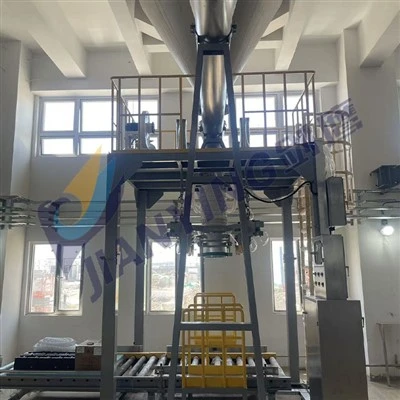
First, we have the hopper: that’s the large, funnel-shaped storage bin at the top of the bagger, holding whatever product you’re packaging—grains, seeds, fertilizer, plastic pellets, even snack food mixes. Operators load bulk product into this hopper, and it feeds into the weighing system below. The key here is that this isn’t just a random drop; the feed is split into two stages, which is how we get that precision. Most net weighing baggers use a two-speed feed: a “fast feed” and a “trim feed.” Fast feed is the initial, high-volume drop of product into the weighing bucket—we call it the “rough cut,” because it’s getting us most of the way to the target weight as quickly as possible. If we only did fast feed, we’d overshoot the mark by a few ounces every time, because product moves fast and has momentum. That’s where trim feed comes in: once the scale’s sensor detects we’re within, say, 95% of the target weight, it switches to a slow, controlled stream of product—just enough to top off the load without going over.
This is where the scale’s heart is: the load cell. A load cell is a little device that converts physical weight into an electrical signal, so the control panel can track how much product is in the weighing bucket in real time. For the machines I supply, we use strain gauge load cells—they’re the industry standard because they’re accurate, durable, and don’t need a lot of maintenance. Older baggers used mechanical springs or levers, which would wear out and get out of alignment after a few years, but strain gauges are sealed, so they don’t get gummed up with dust or powder from the product. That’s a big deal for operations handling dusty goods, like flour or cement, where small debris can wreck unprotected sensors.
Once the trim feed hits the target weight, the gate at the bottom of the weighing bucket opens, and the product drops into the bag below. That bag is held open by a set of clamps, called a “bag mouth.” The clamps are soft, usually rubber-coated, so they don’t tear the thin woven or plastic bags that most operations use, and they’re positioned to center the bag perfectly so product doesn’t spill over the edges. Some baggers even have a venting system here, because when you fill a bag, air gets trapped inside. If you just drop product in, the air can cause the bag to bulge, or even burst during sealing. The venting lets that air escape slowly, so the bag stays evenly filled.
Now, you might be wondering: why not just weigh the bag after it’s filled? Let’s circle back to the net vs. gross thing. If you weigh the full bag, you have to account for the bag’s weight, which means if the bag changes thickness (even by a tiny amount—say, a roll of 1,000 bags has one that’s slightly lighter), your product weight is off. Net weighing measures only the product, so the bag’s weight is irrelevant. That also means you can use thinner, cheaper bags, because you don’t have to overfill them to make up for the bag’s weight. For a 50-pound bag, that can save operations $500 to $1,000 a month just on product and packaging costs—numbers that don’t lie.
Once the product is in the bag, the next step is sealing. For most dry bulk products, we use heat sealing or sewing, depending on the bag material. Woven polypropylene bags, common for fertilizer and birdseed, get sewn shut with a thread that’s strong enough to hold 50 pounds even when the bag’s jostled on a pallet. Plastic bags for snack foods or pet food get heat-sealed, where a heated bar melts the top of the bag and presses it shut for a tight, airtight seal. Some baggers also have a checkweigher at the end, a small extra step that double-checks the bag’s weight right after sealing. If a bag is under or over weight, it gets rejected automatically—no bad bags leaving the line, no customer complaints.
I should mention that not all net weighing baggers are the same. Some are manual, small-scale operations that fill a few hundred bags a day, used by family farms or small craft food producers. Those are simpler, lower-cost, and perfect for small runs. Then there’s industrial-grade automatic baggers, which can fill up to 800 bags an hour, run 24/7, and integrate with full production lines, from bulk storage to palletizing. The machines I supply fall right in the middle—versatile enough for both small craft operations and mid-sized commercial facilities, with easy-to-use control panels that don’t require a degree in engineering to operate.
A lot of operators worry about downtime, especially when production is running on a tight schedule. That’s why the baggers I sell are designed with easy maintenance in mind. The weighing bucket is removable, so you can clean it out quickly if you switch products—say, from rice to birdseed, you don’t have to scrub for hours to get all the old product out. The load cells and feed gates are accessible, so changing a part takes 10 minutes, not a whole shift. I’ve had customers tell me they switched from a competitor’s bagger that broke down every other week to one of mine, and their downtime dropped by 70%. That’s the kind of value I care about, not just selling a machine.
Let’s talk about common problems people run into with net weighing baggers, because it’s not a set-it-and-forget-it machine. A lot of times, operators will notice their weights are off, and they think the scale is broken, but 9 times out of 10, it’s just calibration. Over time, dust or product buildup can throw off the load cell’s readings, so calibrating once a month (or once a week, for dusty operations) keeps everything accurate. Another issue is feed speed: if the fast feed is too fast, it will overshoot the target weight every time, even with the trim feed. We usually train operators to test the feed speed with a few test bags, adjusting the fast feed’s flow to be as close as possible to the target, so the trim feed only has to add a tiny bit. That cuts down on waste and makes the line faster.
I also like to explain to new customers that net weighing baggers aren’t just for large-scale production. Last year, I worked with a small organic farm that was packaging sunflower seeds in 1-pound bags, and they were using a manual scale with a funnel, so a bag would be a little under or over every time, and they were losing about 10% of their product to complaints and returns. They switched to a small net weighing bagger, and now their weights are within 0.5 ounces of the target, their waste dropped to 2%, and they can fill 500 bags a day without extra labor. That’s the difference between a machine that works for you and one that you have to work around.
At the end of the day, a net weighing bagger’s job is simple: fill the right amount of product into a bag, sealed tight, with as little waste and downtime as possible. The science isn’t complicated—precision weighing, controlled feeding, and consistent sealing—but when it’s done right, it saves operations money, time, and headache. If you’re tired of wasteful gross weighing systems, frequent breakdowns, or inconsistent bag weights, I’d encourage you to reach out to talk through your needs. Whether you’re a small craft producer needing 300 bags a day or a large facility needing 10,000, I can help you find the right net weighing bagger that fits your line, your product, and your budget.

Don’t wait another shift dealing with overfilled bags, product waste, or unplanned downtime. Contact us today to discuss your requirements and find the right net weighing bagger solution for your operation.
Small Bagging Machine References
- “Net Weighing Technology for Bulk Packaging,” Packaging World, 2022.
- Strain Gauge Load Cell Applications in Industrial Weighing, Instrumentation Technology Association, 2021.
- “Reducing Packaging Waste with Net Weighing,” Sustainable Packaging Coalition, 2023.
Wuxi Jianying Intelligent Equipment Co., Ltd.
We are one of the most professional net weighing bagger manufacturers and suppliers in China, featured by quality products and good price. Please rest assured to buy durable net weighing bagger for sale here from our factory. Welcome to contact us for custom service and OEM service.
Address: No.88, Xinyang Road, Ehu Town, Xishan District, Wuxi City, Jiangsu Province, P.R.China
E-mail: wuxijianying@163.com
WebSite: https://www.wuxijianying.com/
