If you’ve ever held a perfectly machined part—say, a tiny bearing roller that fits into a car transmission, a medical implant component, or a precision shaft for a robotics arm—you’ve held a product that almost certainly went through a CNC centerless grinder. As a supplier who’s worked with these machines for over 15 years, I’ve heard every question there is about them, but one that still comes up most often (and causes the most confusion) is: what exactly do sensors do in a CNC centerless grinder? A lot of operators and even some engineers I meet on the trade show circuit think sensors are just little add-ons, something you bolt on after the machine is built to “check” if a part is right. Let me stop you there. Sensors are not add-ons. They’re the nervous system of a CNC centerless grinder, and without them, the machine is just a fancy old-fashioned grinding wheel with a computer on top. CNC Centerless Grinder
First, let’s get back to basics: what is a centerless grinder, anyway? Unlike a centered CNC grinder that clamps a part between two centers (like a lathe), a centerless grinder uses two wheels: the grinding wheel that does the cutting, and the regulating wheel that controls the part’s speed and rotation. The part rides on a work blade, with no clamping or center support. That design is why centerless grinders are so good at mass-producing small, precision parts—you can feed a stack of blanks into the machine, and it spits out finished parts 100 per minute. But that also means there’s zero room for error. A part that’s off by just a few microns is useless for aerospace, medical, or automotive applications. Sensors are the only thing keeping that process consistent.
Let’s start with the most critical role: dimensional control. Early centerless grinders relied on operators to adjust the wheel and check parts with micrometers every 20 or 30 pieces. That worked for small runs, but not for high-volume production where even a one-micron shift in the wheel position over an hour would ruin hundreds of parts. Modern CNC centerless grinders use in-process dimensional sensors that sit right above the work blade, touching the part as it moves through the grinder. These sensors take real-time measurements of the part’s diameter, sending that data back to the CNC controller every 100 milliseconds. If the sensor detects the part is .0002 inches over the target diameter, the controller automatically adjusts the position of the grinding wheel, no operator input needed. I’ll never forget a customer who ran 50,000 bearing rollers a day a few years back—before they upgraded to our grinders with in-process sensors, they were scrapping 3% of parts per run. After installation, that scrap rate dropped to .08%. That’s the difference sensors make.
But dimensional control isn’t just about diameter. What about roundness? A part that’s the right diameter but oval won’t fit into a bearing or a tight assembly. Centerless grinders can sometimes cause “lobing”—a slight elliptical shape—if the regulating wheel speed is off, or if the part vibrates as it spins. That’s where vibration sensors come in. Mounted on the machine body near the grinding and regulating wheels, these sensors pick up high-frequency vibrations that are too fast for the human eye to see. If vibration spikes above a set threshold, the controller automatically adjusts the regulating wheel speed or slows the part feed rate to eliminate the issue. A customer in the medical device space was struggling with lobing on hip implant pins a few years ago; their old grinder would produce 10% of parts with unacceptable roundness. Adding vibration sensors cut that to less than 0.5%. It’s not just the pin material that matters—it’s how the machine handles it, and vibration sensors are the first line of defense there.
Next up: process safety and tool monitoring. The grinding wheel on a centerless grinder spins at 10,000 RPM or faster. If the wheel becomes worn, or if a tiny piece of the wheel breaks off mid-process, it’s not just a ruined part—it’s a safety hazard. That’s why we integrate wheel condition sensors into every CNC centerless grinder we sell. These sensors measure the wheel’s dimensional wear over time, tracking how much material is removed per part. If the wheel’s wear rate exceeds normal parameters, the controller triggers an automatic wheel dressing cycle—where a diamond tool trues and dresses the grinding wheel back to its correct shape—before the wheel’s performance drops. Wheel condition sensors also detect if a wheel has become glazed (where metal particles stick to the wheel surface, reducing cutting ability) or loaded, which would cause the wheel to burn the part. A part burn isn’t just scrap—it can compromise the material’s structural integrity, which is a big deal for automotive and aerospace parts. Last year, a defense contractor we work with had a wheel failure on their old grinder that ruined $40,000 worth of parts. Since we installed our grinders with wheel condition and load sensors, they haven’t had a single part burn incident.
Wait, what about thermal stability? That’s another big one I don’t see enough people talking about. Grinding generates a lot of heat, and as the machine’s spindle, wheels, and work blade heat up, they expand ever so slightly. That expansion can shift the part’s position just enough to throw off dimensional accuracy over a long run. Thermal sensors, mounted on the spindle, wheel head, and work blade, track temperature in real time. The controller adjusts the machine’s coolant flow rate or the wheel position to compensate for thermal expansion, keeping parts consistent even during 24-hour production runs. We had a customer who ran 8,000 hours a year on crankshaft pins for heavy-duty trucks; before adding thermal sensors, they had to adjust the machine every two hours to account for heat. After upgrading, they only perform full machine calibrations once a week. That’s not just about accuracy—it’s about operator efficiency, too.
Let’s also talk about part presence and sorting. On high-volume production lines, you can’t afford to have a missing part jamming the machine. Photoelectric sensors and inductive proximity sensors are positioned at the infeed and outfeed of the grinder. The infeed sensor checks that every blank is in place before the cycle starts; if a blank is missing, the machine pauses automatically so operators can fix it, instead of running an empty cycle that wastes materials and time. The outfeed sensor checks that every finished part exits the machine correctly. If a part is out of spec (detected by the dimensional sensors we mentioned earlier), the outfeed sensor diverts that part into a reject bin automatically, so it doesn’t get mixed in with good parts. That’s a huge time-saver for customers who run 24/7—they don’t have to stop the line to sort parts manually.
I know what some of you are thinking: “Sensors are expensive. Why not just use manual checks?” Let’s do the math. A good in-process dimensional sensor might cost a few thousand dollars. A micrometer costs $50. But if you’re running 100 parts a minute, that’s 6,000 parts an hour. If you check every 20 parts, that’s 300 checks an hour. Each check takes 10 seconds— that’s 50 minutes an hour spent just on manual checks, not including downtime for operator delays. Multiply that by the labor cost, plus the cost of scrap parts, and the sensor pays for itself in a week, not to mention the consistency you can’t get with manual checks. I’ve seen customers argue about sensor costs, but nine times out of ten, they come back to us 6 months later asking to add more sensors to their other machines because they see the return on investment.
Now, I want to be clear: sensors aren’t just about replacing operators. They’re about giving operators more time to do what they’re good at—troubleshooting, optimizing production, improving processes—instead of standing there checking parts all day. A good CNC centerless grinder with solid sensors is a collaborative tool between the machine and the operator. The sensor does the repetitive, high-speed monitoring, and the operator uses the data from the sensors to adjust settings, run new part trials, or fix small issues before they become big problems.
Over the years, I’ve seen how much misinformation there is about sensors in CNC centerless grinding. Some people think more sensors equal a better machine, but that’s not true. It’s about the right sensors in the right places, calibrated correctly, and integrated with the CNC controller. For example, a vibration sensor that’s too sensitive will trigger false alerts, stopping the machine for no reason and costing production time. A dimensional sensor that can’t measure at high enough speeds will miss shifts in diameter between parts. That’s why we design our machines with sensors tailored specifically to centerless grinding, not just off-the-shelf parts we bolt on.
If you’re in the market for a CNC centerless grinder, or you’re looking to upgrade your current machine’s capabilities, the first question you should ask isn’t “How big is the wheel?” or “How fast can it run?” It’s “What sensors does this machine have, and what do they do to keep my parts consistent and my line running?” Sensors are the reason a CNC centerless grinder can produce millions of identical, precision parts without a single operator touching them after setup. They’re the quiet workhorse that makes the entire process possible.

If you’re ready to discuss how our CNC centerless grinders with integrated sensor systems can improve your production efficiency, reduce scrap, and boost your quality, reach out to our team to connect for a procurement consultation. We’re here to walk through your specific part requirements, production volumes, and process challenges to find the right solution for you.
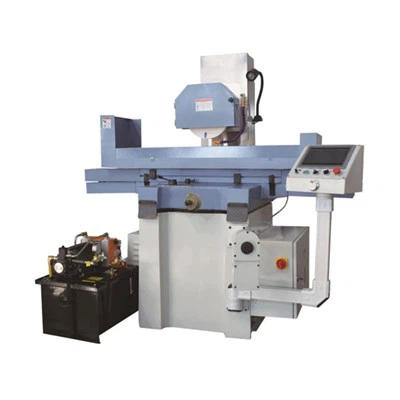
Hydraulic Surface Grinder References
- Stephenson, D. A., & Agapiou, J. S. (2016). Metal Cutting Theory and Practice. CRC Press.
- Centerless Grinding: Technology and Applications. (2020). Society of Manufacturing Engineers.
- ISO 10360-2:2009, Geometrical Product Specifications (GPS) – Acceptance and reverification tests for coordinate measuring machines (CMM) – Part 2: CMMs used for measuring linear dimensions. International Organization for Standardization.
- Tönshoff, H. K., Denkena, B., & Brinksmeier, E. (2012). Precision Grinding: Basics, Technology, and Applications. Springer.
Wuxi Mingxu Machinery Equipment Co., Ltd.
As one of the most professional cnc centerless grinder manufacturers and suppliers in China, we’re featured by quality products and good price. Please rest assured to buy the best cnc centerless grinder for sale here from our factory. Also, custom service is available.
Address: No. 5-5 Jinke Wealth Plaza, Changjiang North Road, Xinwu District, Wuxi City, Jiangsu Province
E-mail: yingyingmxjd@163.com
WebSite: https://www.mingxu-china.com/
